
"Yirgacheffe vs Harar"
5000 article(s) found

Ethiopia's highlands are the birthplace of coffee. Boutique coffee represents the region of Yega Shefi.
The Ethiopian plateau is the birthplace of coffee. In the east, near Harrar, the ancient capital, mocha beans (Harrar,Harari,Harer or Harar) are still produced by traditional drying methods at an altitude of about 2,000 meters above sea level. Halal's texture is medium, with a fruity, wine-like flavor, good Halal's wildness is comparable to the best Yemeni mocha. Dryness in other areas

A brief introduction to the Origin, Development, History and Culture of Essex plus Chuefei Water-washed Wakayega original Fine Coffee beans
Introduction: this bean comes from a single farm Ethiopia and is processed by Waka Cooperative (Worka cooperative). Alemayehu Alako Farm is a member of the Waka Cooperative. The Waka Cooperative, located in the south of Gedeb District, was founded in 2005 and joined the famous Yejia Sheffield Coffee Farmers Cooperative Union (YCFCU,Yirgacheffe Coffee Farmers Co).

Description of Geographical characteristics and Flavor of Coffee beans in Yegashifi Sidamo area
Description of Geographical characteristics and Flavor of Coffee beans in Yegashifi Cedamo production area the highest grades of Cedamo (Yirgacheffe, Sidamo) are Grade 2 and Grade 3 (G2 and G3), and most of the sun-processed coffees in eastern Ethiopia are Grade 4 or Grade 5 (G4, G5). In many cases, level 4 coffee is marked as level 5 in order to reduce taxes. The current grading is not very unified.

Introduction to the story characteristics of Ethiopian boutique coffee beans
The highest grades of Ethiopian coffee are grade 2 and 3 (Yirgacheffe, Sidamo), while sun-processed coffee in eastern Ethiopia is mostly grade 4 or grade 5 (G4, G5). In many cases, the coffee label of level 4
The plateau of Ethiopia, a coffee producing area in the world, is the birthplace of coffee.
The highlands of Ethiopia are the birthplace of coffee. The traditional drying method is still used to produce mocha-Hara beans (Harrar,Harari,Harer or Harar) at an altitude of about 2,000 meters near Harrar in the east. Hara has a medium texture with a fruit wine-like flavor, and a good Hara is as wild as the best Yemenmoka. Dried beans from other areas, such as
Wild mocha coffee beans
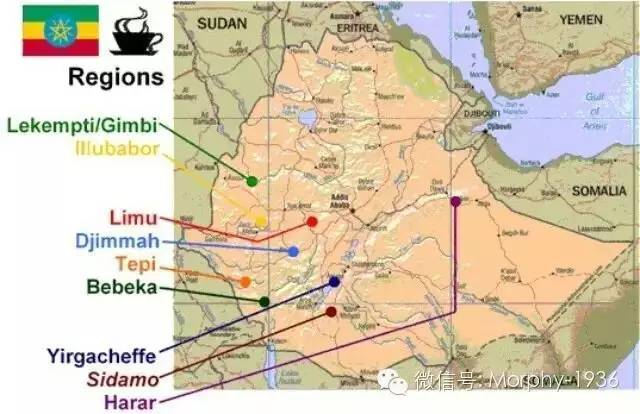
Ethiopia is located in the northeast plateau of Africa, the main producing areas are: Harar, Sidamo, Djimmah, Kaffa
Development of Ethiopian Coffee characteristics of Ethiopian Coffee
Coffee Workshop (official Wechat account cafe_style) Coffee from Africa and Arabia: Ethiopian coffee was originally developed in Yemen as a commercial crop, but Arabica coffee tree originated in the highlands across the Red Sea in western Ethiopia, where people are still harvesting wild berries. Today

Introduction to the flavor and taste characteristics of Ethiopian coffee manor with rich alcohol thickness
The highest grades of Ethiopian washed coffee Yega Chuefei G1 G2 Sidamo (Yirgacheffe, Sidamo) are Grade 2 and Grade 3 (G2, G3), while most of the sun-processed coffee in eastern Ethiopia are Grade 4 or Grade 5 (G4, G5). In many cases, level 4 coffee is marked as level 5 in order to reduce taxes. At present, the grading is not uniform and messy, because there is also sun processing.

Characteristics of grinding degree of Ethiopian coffee with soft acidity introduction to flavor description of varieties
Grade of Ethiopian coffee: Ethiopian washed coffee Yega Chuefei G1 G2 Sidamo (Yirgacheffe, Sidamo) has the highest grades 2 and 3 (G2, G3), while sun-processed coffee in eastern Ethiopia is mostly grade 4 or 5 (G4, G5). In many cases, level 4 coffee is marked as level 5 in order to reduce taxes. At present, the classification is not uniform and there are

The hometown of Ethiopian Arabica Coffee the grade of Ethiopian coffee
Professional coffee knowledge exchange more coffee bean information Please pay attention to the coffee workshop (Wechat official account cafe_style) afraid of insomnia, palpitations, drink decaf coffee is healthier? Are you worried about palpitations, insomnia, or switching to decaffeinated coffee because of pregnancy? When drinking coffee, you want to consume less caffeine, which is actually similar to the variety of coffee beans and the size of grinding particles.

Ethiopian Yerga Coffee Estate Coffee Bean Flavor Description Taste Treatment Introduction
Sidamo grows in the southernmost Ethiopian plateau between 4,600 - 7,200 feet above sea level (Sidamo province), southeast of Jima, due south of the capital, usually sweet and popular with most people. Its annual production is about 225000bags/60kg. The bean is smaller than Longberry, green and gray.

Ethiopian Yejia Coffee Cochel Coffee Bean Flavor description method of producing area taste Grinding scale
The main producing areas of Ethiopian coffee are Harald in the east, Djimmah in the southwest and Sidamo in the south. Yirgacheffe, with its unique aroma, comes from the northwest of Sidamo province.
Introduction of boutique coffee beans Ethiopian coffee
Ethiopia is the hometown of Arabica coffee, and it is in the forests of Kaffa that you can see wild Arabica coffee. In Ethiopian, coffee is called Bun or Buna, and coffee beans (coffeebean) may be translated from Kaffa Bun. Arabica coffee was discovered early in the Harald area, probably from Kafa.

Varieties of Ethiopian coffee beans taste of manor region flavor description method grinding engraving degree introduction
The main producing areas of Ethiopian coffee are Harald in the east, Djimmah in the southwest and Sidamo in the south. Yirgacheffe, with its unique aroma, comes from the northwest of Sidamo province.

What are the beans and varieties of Ethiopian Manor? How is the flavor and taste?
Professional coffee knowledge exchange more coffee bean information please follow the coffee workshop (Wechat official account cafe_style) Ethiopia is the hometown of Arabica coffee, it is in the forests of the Kaffa region that you can see wild Arabica coffee. In Ethiopian, coffee is called Bun or Buna, and coffee beans (coffeebean) may be from Ka

Flavor characteristics of Ethiopian Fine Coffee Ethiopian Coffee
Ethiopia is the hometown of Arabica coffee, and it is in the forests of Kaffa that you can see wild Arabica coffee. In Ethiopian, coffee is called Bun or Buna, and coffee beans (coffeebean) may be translated from Kaffa Bun. Arabica coffee was discovered early in the Harald area, probably from Kafa.

Introduction to the Variety characteristics of Coffee Flavor description treatment method in Yega Ficher Manor, Ethiopia
Yega Chuefei Cochel Manor introduces Yega Chevy Coffee, which seems to be more blessed with favorable conditions. it has a floral aroma, bright citrus acidity, lemon flavor and soft taste. Kochere Cochrane is located in the southwest of Ethiopia, about 25 miles to the north, that is, the famous Yega Chenophen. The mode of production is small-scale production.

Description of the Flavor of Coffee beans in Yejiaxuefei Manor introduction to the planting Environment of Grinding scale varieties
Yirgachaffe coffee is the rarest coffee bean on the market in Ethiopia, which is exported to Japan and Europe, but is rarely seen in the United States. This is because Dallmeyer, a German coffee roaster owned by Nestle, has established close ties with the growers of Yega Snow Coffee.
Exquisite Sidamo Coffee introduces Sidamo Coffee beans famous Coffee Brands
Coffee-tasting Sidamo, Ethiopia 2013-12-18 Wuhan Creek Coffee Ethiopia has two of the best producing areas, Yiragcheffe and Sidamo, among which Sidamo is located in a plateau region south of Ethiopia. Sidamo has a balanced acidity and moderate consistency. In Ethiopia, people usually have a cup of mocha coffee for breakfast to replenish the essence of the day.